
A practical guide to what actually makes a home office comfortable enough to use all day, from chair fit and monitor position to desk sizing, lighting, under-desk clearance, and the kind of movement that prevents a setup from wearing you down.
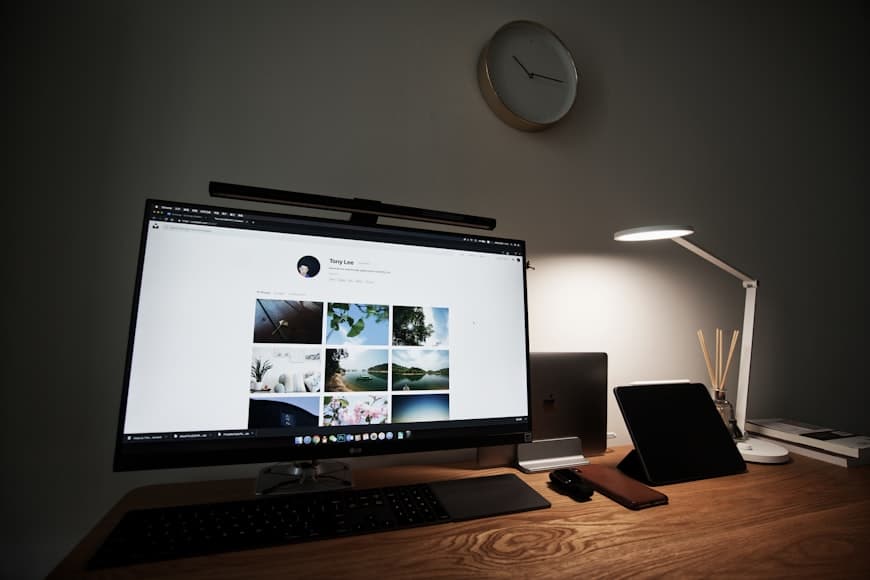
Image source: Unsplash.
A home office feels comfortable all day when the setup stops asking your body to make little compromises every few minutes.
That is usually the real difference.
The chair does not quite fit, so you shift forward. The monitor is a little too close, so your neck stiffens. The keyboard sits a little too high, so your shoulders lift. The lighting is a little wrong, so your eyes stay tense.
None of those problems looks dramatic in isolation.
Together, they are exactly what makes a setup feel tiring even when it looks tidy.
The main workstation guidance from Mayo Clinic and OSHA keeps returning to the same core picture: feet supported, shoulders relaxed, elbows near the body, monitor at a comfortable distance, and enough space for the things you use most often to sit directly in front of you. That is not a checklist for “perfect posture.” It is the baseline that keeps ordinary work from becoming a constant low-grade strain.
So the right question is not:
what product makes a home office comfortable?
It is:
what conditions make a home office stop fighting you?
A home office usually becomes comfortable enough for full workdays when these things are true at the same time:
If one or two of those are off, you can still work.
If several are off, the setup starts draining you.
This matters because a lot of buying mistakes begin with the wrong definition.
A comfortable home office is not necessarily:
Comfort usually looks simpler than people expect.
It usually looks like a setup where your body is not being asked to keep correcting around one bad decision all day long.
That is why comfort often improves more from one right adjustment than from three new products.
People often treat the chair like just one item in the room.
In practice, it is the foundation for all-day comfort.
If the seat height is wrong, your feet dangle or your knees rise too high. If the seat depth is wrong, you either lose thigh support or cannot sit back properly. If the lumbar support lands badly, your lower back either collapses or gets pushed into an uncomfortable shape.
This is why comfort usually starts with:
If the chair itself still feels like the main unknown, How to choose an ergonomic office chair and Ergonomic chair settings that actually improve comfort are the two best next reads. One solves chair selection. The other solves chair setup.
A surprising number of bad workdays are really monitor-position problems.
When the screen is too close:
When the screen is too low or too high:
Mayo Clinic's office-ergonomics guidance is still a useful anchor here: the monitor should usually sit about an arm's length away, and the top of the screen should sit at or slightly below eye level.
That is why monitor comfort is not just about posture aesthetics. It changes how the whole workstation behaves around you.
If the screen still feels like the main problem, go next to How far should a monitor be from your eyes on a small desk? and How high should your monitor be for good posture?.
This is where a lot of setups quietly lose comfort.
The keyboard and mouse are used constantly, so even small positioning mistakes repeat all day:
OSHA's purchasing guide and related workstation guidance keep this simple: the surface should allow the monitor, keyboard, and input device to sit directly in front of the user, with enough room for the items used most often.
That is why a setup can have a good chair and decent monitor placement and still feel bad if the front-center zone is crowded, too high, or too narrow.
If that part sounds familiar, How to position your keyboard and mouse for shoulder comfort is the more specific fix.
People often think desk comfort means “bigger is better.”
That is too simple.
A desk becomes comfortable when it is:
OSHA is explicit that the work surface should be deep enough for the monitor to sit at least 20 inches away and large enough for the monitor, keyboard, and input device. That is why all-day comfort often depends more on honest fit than on ambition.
A desk that is too shallow will make the whole setup feel compressed. A desk that is too large for the room can make the whole room feel stressful.
That is exactly where these pages connect:
Comfort is not just what happens on top of the desk.
It is also what happens underneath it.
If the underside is crowded with drawers, trays, power hardware, or frame elements, the setup may never feel fully relaxed no matter how clean the desktop looks.
OSHA's purchasing guide spells this out clearly: the desk needs enough clearance for knees and feet while sitting in a variety of positions.
That matters because once legroom disappears:
That is why under-desk organization has to stay restrained on tighter setups. Hardware that looks tidy can still make the workstation feel worse.
Lighting is one of the easiest comfort categories to misunderstand.
People often think of it only as brightness.
But the real comfort question is whether the lighting:
OSHA's desk-lighting guidance is straightforward: good lighting depends on the task, and the light source should be adjustable for location, angle, and intensity.
That means the “comfortable” choice is not always the prettiest lamp.
Sometimes the better answer is:
If lighting still feels unresolved, Desk lamps for eye strain and late-night work and Do you need a monitor light bar if you already have a desk lamp? are the right companions.
One of the most common myths in home-office content is that comfort means holding the perfect position all day.
That is usually not how real comfort works.
A better setup lets you:
This is why supported recline, chair adjustability, and a calm reach zone matter so much. The goal is not to pin the body into one shape. The goal is to let the body move without leaving support behind every time you change posture.
Not every comfort problem is biomechanical.
Some setups feel tiring because they are visually or functionally chaotic:
That kind of clutter forces low-level friction all day.
You keep adjusting around it. You keep making micro-decisions around it. You keep protecting a shrinking amount of actual working space.
That is one reason Why your small desk setup still feels cramped and How to set up a small desk without losing usable space matter even if your question sounds like “comfort,” not “organization.”
This is the part most people need.
If your home office is uncomfortable right now, do not start by buying randomly across categories.
Start here instead:
That order matters because it separates:
Very often the setup feels bad because one foundational condition is wrong, not because the whole workstation needs replacing.
Most bad home-office days fall into one of these patterns:
That usually points to:
That usually points to:
That usually points to:
Recognizing which pattern you are in matters more than buying the next promising fix.
If a home office still does not feel good after a few hours, the problem is usually living in one of these buckets:
That is the useful checklist.
You do not need every product category solved at once.
You need the workstation to stop asking your body and attention to keep compensating.
A home office becomes comfortable enough to use all day when the chair, desk, screen, input zone, lighting, and clearance all support the same goal:
working without constant small corrections.
That is why comfort is rarely one product decision.
It is usually the result of a setup where:
Once those are in place, long workdays usually feel very different.

A practical guide to why an expensive ergonomic chair can still feel wrong, with clearer checks for seat depth, lumbar position, armrest interference, desk-height mismatch, and body-fit issues before you blame price or buy another fix.

A practical guide to what to do when your desk and chair height do not match, with a clearer order for fitting the chair to your body first, fixing foot support, calming the keyboard-and-mouse zone, and deciding when the mismatch is real enough to justify replacement.