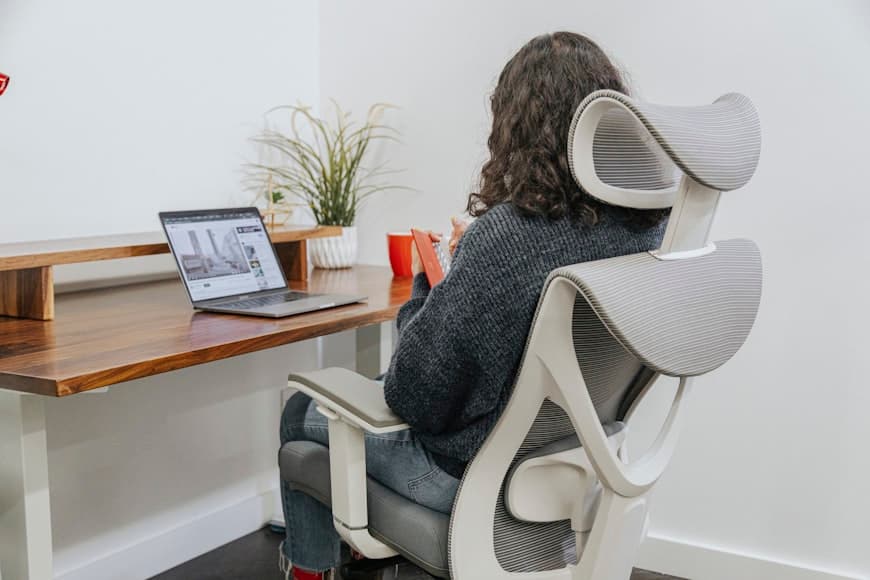
Branch Ergonomic Chair and Autonomous ErgoChair Pro are close enough in price that the decision can feel messier than it should.
That usually means the real question is being asked too vaguely.
These chairs are not trying to win in the same way:
Branch leans into a cleaner profile, simpler ergonomics, and stronger home-office fit.; Autonomous leans into a bigger adjustment list, a heavier-duty frame story, and a more technical chair identity.
If you compare them only by marketing language, they both sound strong. If you compare them by actual day-to-day use, the split becomes clearer.
Quick verdict
Choose Branch Ergonomic Chair if you want the cleaner-looking chair, stronger warranty coverage, and a more apartment-friendly footprint.; Choose Autonomous ErgoChair Pro if you want the more adjustment-heavy chair, a headrest included, and a roomier, more technical workstation feel.
That is the short answer.
The longer answer is that Branch is usually easier to recommend for visible home offices, while ErgoChair Pro is usually easier to recommend for buyers who want more tuning and are comfortable with a slightly bulkier chair.
Strong fit for cleaner-profile setups
A cleaner, more home-friendly ergonomic chair with strong core adjustments, firmer lumbar support, and a much stronger warranty story.
- Official Branch price checked at $359 on March 31, 2026
- Eight points of adjustment and 275 lb support
- 7-year warranty and removable 3D armrests
1. Price gap: closer than it looks, but not identical
This comparison only makes sense because the pricing lives in the same general neighborhood.
When I checked the current official product pages on March 31, 2026:
Branch Ergonomic Chair was listed at $359; Autonomous ErgoChair Pro started at $399 for the foam version; the mesh version of ErgoChair Pro was listed higher, at $449.
That means ErgoChair Pro is not wildly more expensive, but it is still not a perfect apples-to-apples buy if you want the mesh version.
So the practical framing is:
Branch is the lower-friction buy; Autonomous asks for a little more money in exchange for more features on paper.
Whether that extra paper value matters depends on what kind of chair you actually want to live with.
2. Branch is smaller and calmer, Autonomous is larger and more technical
This is one of the clearest real-world differences.
Branch's current Ergonomic Chair listing is still anchored around a compact home-office-friendly footprint. Branch describes:
25" W x 24" D x 38" to 42" H; seat height from 17" to 21"; seat depth from 18" to 22"; 3D removable armrests; height-adjustable and removable lumbar rest; support for 275 pounds.
Autonomous positions ErgoChair Pro differently. On the current official product page, the foam version lists:
29" L x 29" W x 46" to 50" H; seat dimensions of 19" x 19"; seat depth range from 19" to 21.5"; seat height from 18.5" to 22"; weight capacity of 300 pounds.
Even before you sit in them, the personality difference is obvious:
Branch looks like a cleaner modern home-office chair; Autonomous looks like a more feature-led ergonomic workstation chair.
If your setup sits in a bedroom, living area, or more visible corner, that difference matters more than spec-sheet comparisons usually admit.
3. ErgoChair Pro wins on raw adjustment count
If you only compare the adjustment story, Autonomous has the more aggressive pitch.
Autonomous currently describes ErgoChair Pro with:
9 intuitive adjustment points; adjustable headrest; adjustable armrests; adjustable lumbar support; adjustable seat depth; adjustable seat height; back tilt angle and tension controls.
That is a lot for this price band.
Branch also gives you a credible ergonomic setup. Its current product copy still emphasizes:
eight points of adjustment; 3D removable armrests; seat depth adjustment; seat-height adjustment; tilt and tilt tension; adjustable and removable lumbar support.
That is enough for most home-office buyers.
So the difference is not that Branch lacks adjustability. It is that Autonomous pushes a more obviously feature-dense chair experience, especially because the headrest is part of the default pitch.
If your buying instinct is "I want the chair with more controls," ErgoChair Pro is the more natural pick.
4. Branch makes the cleaner home-office argument
Branch is easier to recommend when the room itself matters.
Its profile is smaller, the design language is calmer, and the whole product feels more like something chosen for a modern apartment or a tidy home office rather than a chair pulled from a corporate spec sheet.
That matters in rooms where the chair is visible all day.
Autonomous is not ugly, but it reads more technical:
larger frame; bigger overall proportions; more obvious ergonomic hardware; stronger "workstation" identity.
So if your main question is:
Which chair will feel less visually heavy in a home office?
the answer is usually Branch.
If your question is:
Which chair looks more like it was built around adjustment depth and ergonomic hardware first?
the answer is usually Autonomous.
5. Warranty is one of the strongest reasons to choose Branch
This is where the comparison gets sharper.
Branch currently backs the Ergonomic Chair with a 7-year warranty. Autonomous currently backs ErgoChair Pro with a 2-year warranty.
That is a meaningful gap, not a rounding error.
When two chairs are relatively close in price, warranty coverage becomes a much more useful proxy for long-term confidence. Branch is simply easier to defend here.
Autonomous still makes a case through features and a higher weight rating, but if you care about:
longer ownership confidence; fewer replacement worries; stronger peace of mind for the money.
Branch has the better argument.
6. Seat feel and posture logic are not exactly the same
Autonomous leans harder into movement and recline mechanics. Its current copy highlights a 2-to-1 recline ratio, a level seat while the back reclines, and a lumbar cushion that moves up and down to fit different users.
Branch leans more into support simplicity:
contoured upper backrest; firm lumbar support; breathable mesh; synchronous tilt that links backrest and seat movement.
Both are credible ergonomic approaches.
The cleaner interpretation is:
Branch is built around a simpler support package that feels easier to understand and easier to integrate into a normal home-office setup; Autonomous is built around a more active, more adjustable chair experience with more obvious ergonomic hardware.
If you are the kind of buyer who likes dialing in fit precisely, Autonomous gets more attractive.
If you want the chair to disappear into a steady daily routine after a short setup, Branch often makes more sense.
7. Which one should you actually buy?
Buy Branch Ergonomic Chair if:
your home office is visible and design-sensitive; you want strong core ergonomics without a bulky chair; you care about warranty coverage; you want the simpler, lower-friction decision.
Buy Autonomous ErgoChair Pro if:
you want more adjustment points on paper; you want an included headrest; you want a slightly roomier, heavier-duty chair; you are comfortable trading warranty strength for extra feature density.
If you want the easier home-office recommendation, start with Branch Ergonomic Chair.
It is smaller, calmer, better-backed, and easier to defend for people who want ergonomic support without making the room feel more corporate than it needs to.
If you want the more adjustable and more technical chair, Autonomous ErgoChair Pro is the stronger fit.
It gives you more tuning, a higher weight rating, and a more feature-heavy ergonomic package, but it also asks you to accept a larger footprint and a much shorter warranty.
That is the real tradeoff, and it is much more useful than treating the two chairs like interchangeable mid-range picks.