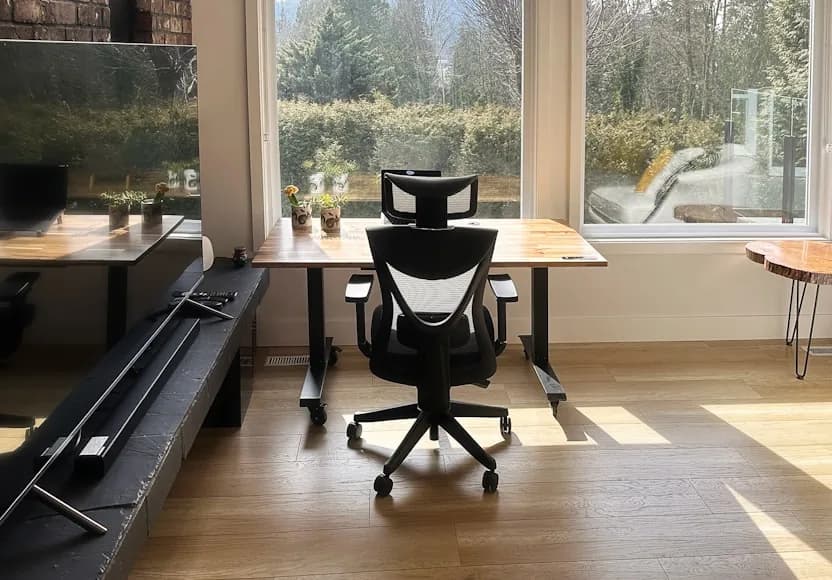

Most people shop for ergonomic chairs backward. They start with the label, the styling, or the brand name, and only later discover that the chair does not fit their desk, their height, or the way they actually work.
A better way to buy is to ignore the word "ergonomic" at first and focus on the things that actually change comfort:
seat height; seat depth; lumbar support; armrest range; recline behavior; how the chair fits your room and desk.
That sounds simple, but it is the difference between buying a chair that looks impressive online and buying one that still feels right after a few full workdays.
This page is about buying criteria before you spend. If you already own the chair and it feels wrong, Why your expensive ergonomic chair still feels wrong is the better diagnostic page.
Start with your desk, not the chair
An office chair does not exist on its own. It has to work with the height of your desk, the position of your monitor, and the space under the work surface.
Official workstation guidance from sources like OSHA and Mayo Clinic follows the same basic pattern: your feet should rest flat on the floor or on a footrest, your thighs should be roughly parallel to the floor, and your shoulders should stay relaxed rather than lifted. If a chair only feels comfortable when you are reaching upward to the desk or pointing your toes downward, the setup is wrong even if the chair itself is expensive.
That means your first question should be:
Can this chair adjust to the desk I already have?
If the answer is not obvious from the seat-height range and armrest behavior, keep looking.
1. Seat height is the first fit test
Seat height is the fastest way to tell whether a chair can work for you. When the height is right:
your feet stay flat; your knees are not forced sharply upward; your thighs feel supported without pressure behind the knees; your shoulders do not rise to meet the desk.
This is also why a desk that is too high can ruin an otherwise good chair. If you have to raise the chair too much just to reach the keyboard, you may end up dangling your feet or compressing the back of your legs. In that case, a footrest can help, but the better long-term fix is a desk and chair combination that works together more naturally. If you are choosing one now, Footrests that improve desk posture and circulation covers the strongest current options.
If you already bought a higher-end chair and it still feels strangely disappointing, Why your expensive ergonomic chair still feels wrong is the better next diagnostic page before you assume the whole category is hype.
2. Seat depth matters more than most people expect
Seat depth is one of the most overlooked chair specs, especially online. A seat that is too deep pushes shorter users forward so they cannot use the backrest properly. A seat that is too shallow may leave taller users feeling under-supported.
The goal is simple: you should be able to sit all the way back into the chair while keeping a little space between the front edge of the seat and the back of your knees. If the seat touches the back of your knees when you are fully seated, it is probably too deep for you unless the chair has seat-depth adjustment.
This is one reason adjustable seat depth is such a strong signal in chair shopping. It makes the chair more adaptable to different body types and usually means the chair is being designed around real fit rather than pure appearance.
3. Lumbar support should meet your back, not fight it
Good lumbar support is not about feeling a giant lump in the lower back. It is about supporting the natural curve of the spine so you are not collapsing into the chair after an hour.
Look for:
adjustable lumbar height; a backrest shape that supports your lower back without forcing you forward; a design that still feels supportive when you recline slightly.
If lumbar support is fixed and hits you in the wrong place, the chair may always feel "off" no matter how many other adjustments it offers.
4. Armrests should reduce tension, not create it
Armrests are helpful when they let your forearms rest lightly while your shoulders stay relaxed. They become a problem when they force your elbows outward, block you from getting close to the desk, or sit too high under the work surface.
The most useful armrests usually allow some combination of:
height adjustment; width adjustment; front-to-back movement; pivot or angle adjustment.
If you work at a smaller desk, this matters even more. Fixed armrests can make a chair feel much larger than it really is because they stop you from tucking in cleanly.
5. Recline and movement matter for long sessions
The best ergonomic chairs are not trying to lock you into one rigid posture all day. They support movement. A good recline lets you lean back without losing control of the chair or feeling like the lumbar support disappears the second you move.
What to look for:
smooth recline tension; a backstop or lock if you want defined positions; stable support while you shift posture during the day.
If a chair only feels good when you are sitting perfectly upright and still, it probably will not feel good for very long.
6. Do not ignore room fit and visual bulk
This is the part many buying guides skip. A chair can be ergonomically strong and still be the wrong choice if it overwhelms your room.
For small apartments, bedroom offices, or living-room corners, consider:
overall width, including armrests; visual bulk of the backrest and frame; whether the chair can slide under the desk cleanly; whether the casters and base need more clearance than your layout allows.
If your setup is visible all day, a chair with a cleaner profile may be a better long-term choice than a bulkier commercial-style model, even if both have strong adjustment sets.
A fast ergonomic chair checklist
Before you buy, run through this list:
- Does the chair's seat-height range work with my desk?
- Can I sit fully back without pressure behind my knees?
- Is lumbar support adjustable or at least shaped well for my lower back?
- Will the armrests let me sit close to the desk?
- Does the recline support movement instead of fighting it?
- Will the chair physically and visually fit the room?
If you cannot answer most of those questions from the listing or the official spec sheet, the chair is still too much of a gamble.
Red flags that usually mean "skip it"
The listing says "ergonomic" but barely describes the adjustments.; The seat depth is fixed and not clearly suited to your body size.; The armrests look high and non-removable for a compact desk.; The chair seems oversized for your room or desk width.; There is no clear mention of lumbar support behavior.
Marketing language is cheap. Adjustment details are what matter.
A simple buying strategy that works
If you want the safest process, buy in this order:
- confirm your desk height and available room
- shortlist chairs with the right seat-height range
- prioritize seat-depth adjustment and lumbar support
- check armrest flexibility
- only then compare style, upholstery, and secondary features
That order keeps you focused on fit first, which is where most chair-buying mistakes start.
Where to go next
If you already know lower-back support is your top concern, start here:
Ergonomic office chairs for lower back support; Office chairs under $300 for home offices.
If your main challenge is fitting a full workstation into a tighter room, read:
Home office setup ideas for small apartments; Standing desks that fit small spaces.
And if monitor height is still part of the problem, pair the chair decision with:
Should you buy a better chair, a bigger desk, or a monitor arm first?; What makes a home office comfortable enough to use all day?; Monitor risers that improve posture and desk organization; Why your expensive ergonomic chair still feels wrong.
Sources
- OSHA Computer Workstations eTool — seat height, foot support, thigh angle, lumbar support, and armrest criteria
- Mayo Clinic: Office ergonomics — workstation setup guidance covering chair, desk, keyboard, and monitor as a connected system
- CCOHS Office Ergonomics — Canadian occupational health guidance on seated posture, viewing distance, and monitor height