
Most desk footrest advice gets framed like a comfort extra.
That is not really the useful way to think about it.
A footrest matters most when the rest of the workstation is almost right but not quite. Maybe the desk is a little too high. Maybe you had to raise the chair to get your elbows in the right place. Maybe your feet do not stay planted unless you tuck them under the chair or hook them around the base.
That is the real use case.
OSHA and Mayo Clinic keep the same basic target in view: feet supported, thighs comfortable, shoulders relaxed, and arms able to reach the keyboard without hiking upward. A good footrest can help you get there when the desk height is not fully on your side.
The important part is choosing the right kind of footrest.
Some are better for stable support and angle adjustment. Some are better for gentle movement during long sitting sessions. Some are basically cushioned wedges that feel pleasant but do not solve much if the real problem is desk height.
This guide stays focused on the footrests that make the most practical sense for posture and day-to-day desk use based on current official specs.
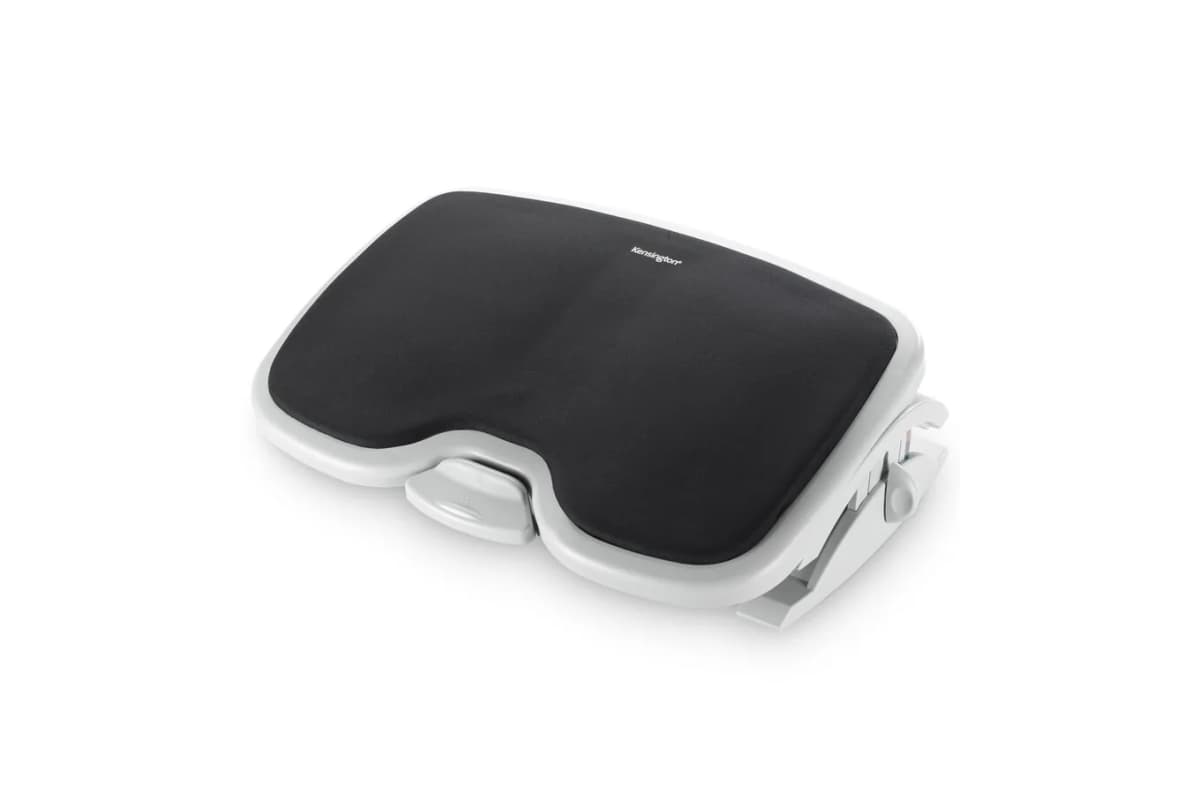
- overall adjustable footrest: Kensington SoleMate Comfort Footrest with SmartFit
- Strong fit for movement and circulation: Fellowes Breyta Foot Rest
- budget active pick: Mount-It! Dual Pedal Ergonomic Footrest
- soft-support option: Secretlab Premium Footrest (PlushCell Memory Foam)
How we narrowed the list
This roundup was built around real workstation use, not comfort-marketing language.
The footrests here had to do at least one of these jobs well:
provide enough height and angle to support feet after the chair is raised to desk height; stay stable under the desk instead of sliding or compressing too easily; support either fixed posture control or gentle movement in a deliberate way; make sense from current official size, adjustability, and materials information.
That is why softer lounge-style foot cushions did not make the cut. The goal here is lower-body support that actually helps the workstation fit better.
A more fully adjustable office footrest with a memory foam surface, a useful height-and-angle range, and a pedal control that makes fine tuning easier at the desk.
- Height adjusts from 3.5 to 5 inches
- Angle adjusts up to 30 degrees with 0 to 15 degrees of tilt
- Memory foam pad and locking foot pedal control
A lighter, movement-friendly footrest with three height options, a rocking mode, and a broad platform that makes sense for long sitting sessions.
- Three height settings plus a rocking option
- 49 x 36 cm platform
- 5-year limited warranty
A budget-friendly hard-platform footrest that leans into movement, with independent pedals, a massage texture, and two simple height settings.
- Two height levels: 4.1 and 5.1 inches
- 0 to 25 degrees of tilt
- Independent pedals and anti-skid feet
What matters most in a desk footrest
The biggest mistake here is assuming every footrest solves the same problem.
They do not.
For desk posture, the specs that matter most are:
effective height: can it actually meet your feet after you raise the chair to keyboard height?; stability: does it stay planted instead of sliding or tipping?; angle or rocking behavior: do you need static support or some movement during long sitting sessions?; surface feel: do you want a hard platform, a textured surface, or soft foam pressure relief?; usable platform size: does it comfortably support both feet without making you hover at the edges?
This is also where a footrest is different from a small ottoman or random cushion under the desk.
A real desk footrest should help you keep the lower body in a supported, repeatable position. If it compresses too much, moves unpredictably, or sits at the wrong height, it stops helping and turns into desk clutter.
1. Kensington SoleMate Comfort Footrest with SmartFit
Kensington's SoleMate Comfort Footrest is the strongest all-around pick when the problem is not only softness, but actual workstation adjustment.
Kensington's official product page highlights the SmartFit system, a memory-foam pad, and a setup that is both height- and angle-adjustable. The current official spec detail is what makes it stand out:
height adjusts from 89 mm to 127 mm (3.5" to 5"); angle adjusts up to 30 degrees; tilt runs from 0 to 15 degrees; a locking foot pedal control lets you adjust it without leaving the chair; limited 2-year warranty.
That is a better spec profile than the average hard-plastic footrest.
If you are using a fixed desk and have to raise the chair to get your elbows and keyboard relationship right, this kind of adjustable range is much more useful than a simple foam block. It gives you a better chance of keeping the feet supported without improvising with books, boxes, or awkward knee angles.
The memory-foam top also makes it more forgiving than harder office footrests.
Strong fit for: people who want one footrest that can handle real desk-height mismatch instead of only adding softness.
Main tradeoff: it is more mechanical and more office-looking than the softer, simpler options.
2. Fellowes Breyta Foot Rest
The Breyta is the better pick when you know static support alone is not the whole answer.
Fellowes' official Breyta documentation makes the product positioning very clear. It is built around:
three height adjustments; a rocking option; movement intended to improve circulation; a 49 x 36 cm platform; 0 to 18 degrees of rocking; a textured surface; portable design; 5-year limited warranty.
That is a thoughtful mix.
Some people do better with a footrest that gives them a place to plant the feet. Others do better with a footrest that encourages a bit of movement throughout the day, especially if they tend to lock into one position for hours. The Breyta is stronger for that second group.
It is also a better choice than bulkier office-style footrests if you want something easier to move, store, or shift between work zones.
Strong fit for: users who want support plus gentle movement during long sitting sessions.
Main tradeoff: it is less fine-tunable than a more mechanically adjustable option like the Kensington.
3. Mount-It! Dual Pedal Ergonomic Footrest
Mount-It!'s dual-pedal footrest is the value pick when you want movement and a hard platform without paying for a more premium office-footrest build.
Mount-It!'s official product page for the MI-7811 emphasizes the same core idea repeatedly:
independent pedals encourage intuitive movement; the design aims to support improved circulation; the massage surface targets pressure points; there are two height settings; the footrest uses anti-skid feet.
The page also gives a helpful spec summary:
height settings of 4.1" and 5.1"; 0 to 25 degrees of tilt; 16.8" x 12.6" product dimensions; high impact polystyrene construction.
This is not the most elegant product in the group, and it does not pretend to be.
What it does give you is a clear movement-oriented design at a more approachable level. If you want something more dynamic than a fixed wedge and you do not need a premium finish, it makes practical sense.
Strong fit for: buyers who want an active footrest with real movement features at a lower cost.
Main tradeoff: smaller platform, simpler construction, and a more utilitarian feel than the top picks.
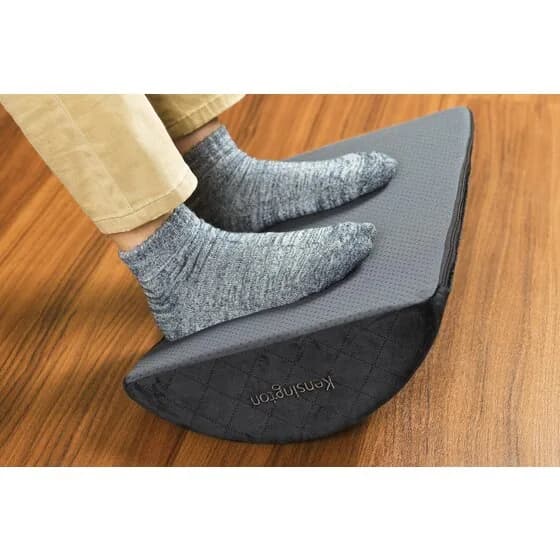
4. Secretlab Premium Footrest
The Secretlab Premium Footrest is the right answer when the real priority is softer under-foot support rather than mechanical adjustability.
Secretlab's official page frames it as a PlushCell memory-foam footrest built for soft-touch support. The currently visible official details also include:
dimensions of 21.7" x 11.8" x 5.1"; hand-washable fabric cover; anti-slip silicone patterned base; design language built to work with Secretlab chairs.
That profile makes it a very different type of recommendation from the Kensington, Fellowes, or Mount-It options.
This is not the pick for someone trying to fine-tune a difficult fixed-height desk. It is the pick for someone who already has the chair and desk relationship mostly under control and wants a softer place to rest the feet.
That can still be useful. Hard platforms are not universally comfortable, especially if you work in socks, prefer a softer feel, or find rigid textured surfaces distracting.
Strong fit for: people who want softer support and pressure relief more than adjustable office-footrest mechanics.
Main tradeoff: less height control and less circulation-focused movement than the harder platform options.
Do you actually need a footrest?
Usually, yes, if this is happening:
you raise the chair to reach the keyboard and your feet stop sitting flat; your thighs feel compressed because you are trying to keep contact with the floor; you keep wrapping your feet around the chair base or tucking them under the seat; your desk is fixed-height and only a little too tall for you.
Usually, no, if the real problem is this:
the desk is dramatically too high or too low; there is no leg clearance under the desk; the chair itself does not adjust well enough to fit you.
A footrest helps when the workstation is close but not fully dialed in.
It does not fix a fundamentally bad desk-and-chair relationship.
If you are still sorting out that larger setup, start with Ergonomic chair settings that actually improve comfort and How to position your keyboard and mouse for shoulder comfort before assuming the problem is only under the desk.
Which one should you actually buy?
Use this shortcut:
choose Kensington SoleMate Comfort if you want the strongest all-around adjustable office footrest; choose Fellowes Breyta if you want support plus more movement during long sitting sessions; choose Mount-It! Dual Pedal Ergonomic Footrest if you want a budget-friendly active footrest; choose Secretlab Premium Footrest if soft under-foot comfort matters more than adjustability.
That is the most practical way to shop this category.
Most people do not need the fanciest-looking footrest. They need the one that actually matches the reason their feet are unsupported in the first place.
Bottom line
The best desk footrest is not automatically the softest one or the cheapest one.
It is the one that helps the rest of the workstation make more sense.
If you need real height and angle adjustment, start with the Kensington SoleMate Comfort Footrest with SmartFit. If you want more movement through the day, Fellowes Breyta is the better fit. If you want a lower-cost active platform, Mount-It! Dual Pedal Ergonomic Footrest is the clean budget pick. And if softer comfort matters most, Secretlab Premium Footrest is the more sensible direction.
That is a much better framework than treating every footrest like the same piece of desk fluff.