
Most setup regrets start with a purchase that sounded reasonable and solved the wrong problem. The pattern matters more than the product category.

Image source: Pexels.
Desk setup regret usually does not start with something obviously foolish.
It starts with a purchase that sounded completely reasonable at the time.
A chair that was on sale. A larger desk that looked like a fresh start. A monitor arm that promised instant space. A bundle of accessories that felt cheaper than solving the real problem properly.
Most people do not waste money because they bought something random. They waste money because they bought a plausible fix before they were honest about what was actually failing.
That is why the same workstation guidance from Mayo Clinic, OSHA, Cornell, and CCOHS keeps circling back to boring fundamentals: the body needs support, the screen needs a usable position, the keyboard and mouse need a calm reach zone, and the desk still has to fit the work without boxing the body in. Regret usually shows up when a purchase tries to decorate around one of those basics instead of fixing it.
The purchases people regret most usually share the same shape: they were bought to compensate for a bigger problem, they felt easier than facing the real constraint, and they improved one visible detail without improving daily use.
That is why regret often sounds the same too: "I spent more and it still feels wrong," "It looks better, but I still don't like using it," "I probably should have fixed the desk first," or "I bought the accessory before I knew what was actually bothering me."
The useful question is not "what do people regret buying?"
It is:
what kind of purchase keeps getting asked to do the wrong job?
This may be the most common regret pattern on any setup budget.
People buy a chair because the discount looks strong, the brand sounds reputable, the silhouette reads more "ergonomic," or the chair simply feels like the most adult or permanent upgrade on the list.
Then a few weeks later the same problems are still there: thighs feel crowded, feet do not land properly, shoulders rise to meet the desk, and the backrest never really supports the way they sit.
At that point, the regret is not "I should never have bought a chair."
It is:
I bought a chair before I knew whether the real issue was fit, desk height, or the whole desk-chair relationship.
That is why Why your expensive ergonomic chair still feels wrong, What to do when your desk and chair height don't match, and How to choose an ergonomic office chair are more useful than treating "better chair" as an automatic fix.
This regret is quieter, but it shows up a lot.
A bigger desk feels like the honest answer when the current one is crowded. Sometimes it really is. But people also regret desks that swallow too much of the room, push circulation into awkward paths, force the chair too close to the bed, wall, or storage, or create a larger surface without solving the real support problem.
The desk feels impressive on delivery day and invasive two weeks later.
That is the risk of buying more furniture before checking whether the real problem was a bad monitor position, poor body support, too many permanent objects on the surface, or a room plan that was never believable to begin with.
This is where 7 questions to ask before buying a desk for a small room and How to plan a workspace in a small room before you buy anything matter so much. A desk can be generous on paper and still feel wrong in the room.
Monitor arms are one of the easiest categories to oversell.
They are useful. They can recover depth, improve screen placement, and calm the main work zone. But they also get bought in situations where the desk is still the real problem.
That usually looks like a desk that is too small even after the stand disappears, a top that does not really suit clamping hardware, a layout where the screen was only one part of the crowding, or a buyer hoping the arm will save them from replacing the desk.
When the arm works, it feels brilliant.
When it does not, the regret is not really about the arm. It is about expecting one elegant piece of hardware to turn an undersized or unstable desk into the right desk.
That is why Should you buy a better chair, a bigger desk, or a monitor arm first? and Monitor arm vs monitor riser: which is better for posture? are the better decision pages before buying the arm on reflex.
This is probably the broadest regret category.
None of these items are automatically bad: a riser, a desk shelf, a cable tray, a mat, a drawer, a stand, or a new lamp can all be reasonable.
The regret starts when several of them arrive before the setup has a stable center.
Then the desk looks more equipped, but daily work still feels cramped, visually noisy, or physically awkward. The buyer did not make one terrible purchase. They made five medium-reasonable purchases before deciding what the setup actually needed.
That is exactly the pattern behind Why more desk accessories rarely fix the real problem.
Accessory regret is usually not:
I should never have bought this category.
It is:
I bought this category too early.
This is the regret people do not always describe as regret.
They say some variation of the same thing: "It still doesn't feel finished," "It looks nicer, but I don't enjoy it more," or "I spent money and somehow the setup still feels cheap."
That usually means the money landed in the wrong layer.
Lighting, nicer materials, a cleaner shelf, or a more design-led object can help a lot once the fundamentals are already credible. But if the chair fit is still off, the desk is still too crowded, or the monitor still dominates the surface badly, a more premium purchase often just makes the mismatch more expensive-looking.
That is the difference between spending on atmosphere after the setup is stable and spending on atmosphere because the setup still does not feel right.
What makes a desk setup feel premium without wasting space or money works best after the setup has earned that layer.
The safest purchases usually share a different pattern.
They usually do one of four things well: remove a daily physical compromise, recover the main working zone, make another purchase unnecessary, or help the setup behave more honestly instead of more impressively.
That often means people regret the pile of accessories far more than one well-chosen support fix, one monitor-position change, or one honest decision to save for the desk instead of decorating around the wrong one.
This is why What to upgrade first with a $300 setup budget matters so much. Limited budgets punish scattered shopping and reward the purchase that removes the biggest constraint first.
If you want one filter that prevents a lot of regret, use these four questions:
Those questions are boring.
They are also much cheaper than learning the answer after the return window closes.
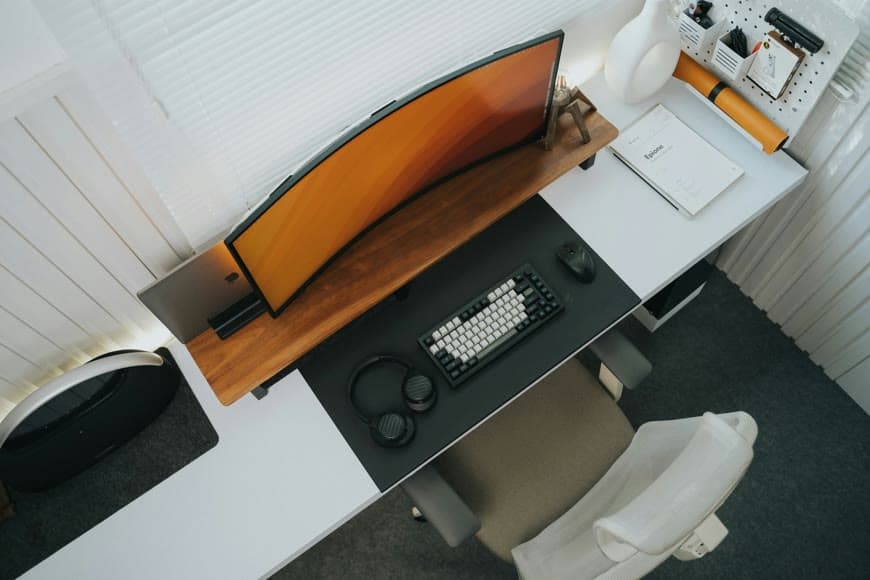
Premium setups usually feel restrained before they feel expensive. The difference usually comes from a few details that create that effect and the discipline to skip the rest.

If your body hurts, your desk feels cramped, and your monitor sits too low, all three upgrades can sound necessary. The real job is figuring out which problem is limiting the setup first.