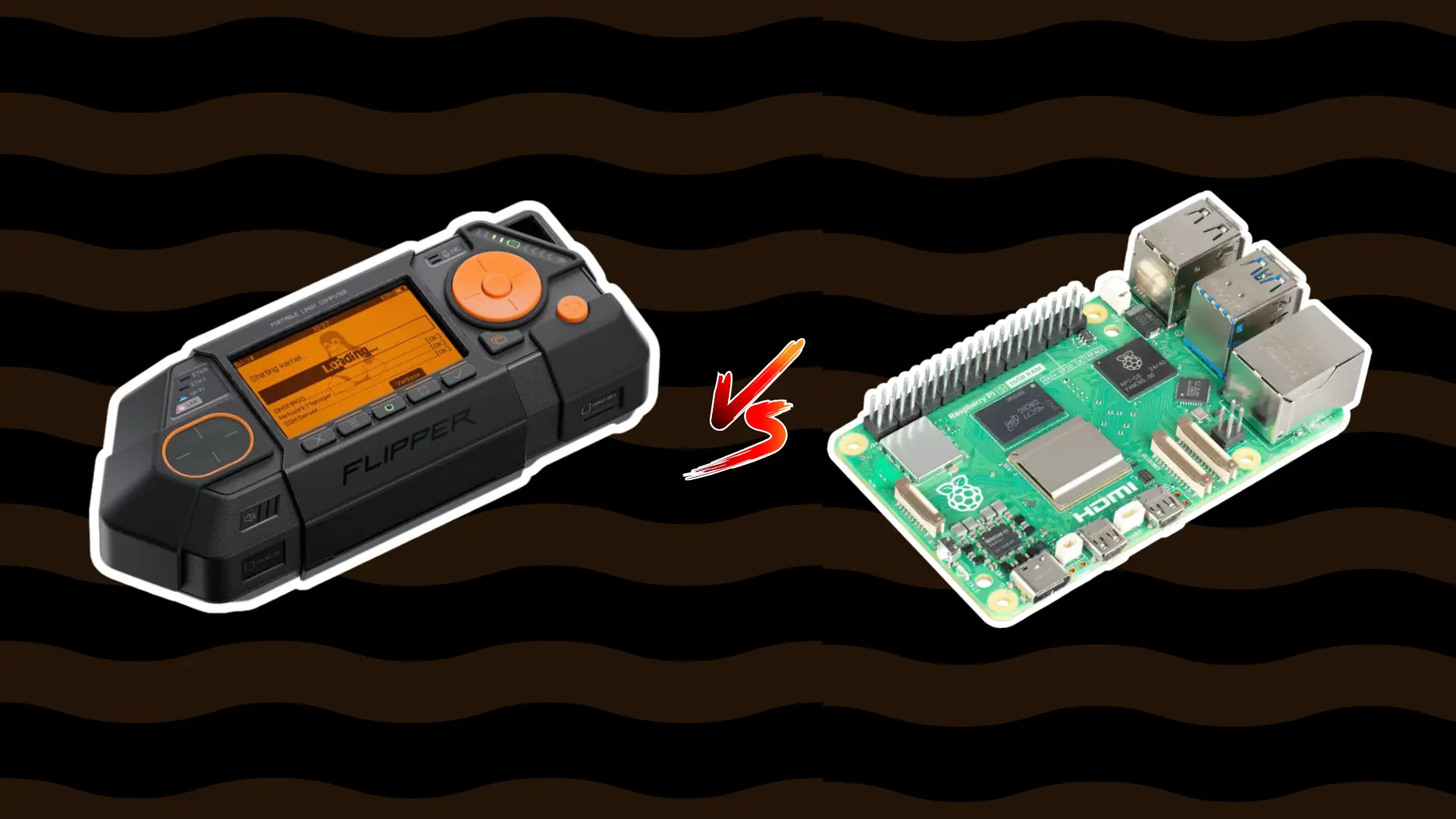
Nearly six years after the Flipper Zero turned into a cultural phenomenon — racking up over a million units sold and more than $150 million in revenue, plus a string of government ban attempts that only made people want it more — Flipper Devices is back with something far more ambitious. The Flipper One is not a sequel. It's not an upgrade. According to the company, it's an entirely different animal: a pocket-sized, open-source Linux computer built for the IP-connected world, and in some meaningful ways, a direct challenge to the Raspberry Pi.
But before you get too excited, there's a catch. You can't buy it yet. Flipper isn't even close to taking orders. What the company announced this week is the device as a project — hardware that exists and works, a developer portal, a Collabora partnership to push the Rockchip RK3576 chip into mainline Linux, and an open call for contributors. CEO Pavel Zhovner has been unusually candid about the uncertainty involved, citing technical challenges and financial risks like the ongoing RAM chip crisis as real obstacles. There is currently no announced price, release date, or crowdfunding campaign—just an open invitation for the community to help finish it.
So what exactly is the Flipper One, and does it hold up against a Raspberry Pi 5?
The hardware
Under the hood, the Flipper One is built around the Rockchip RK3576, an eight-core ARM SoC with four Cortex-A72 cores running up to 2.2 GHz and four Cortex-A53 efficiency cores, an ARM Mali-G52 GPU, and a 6 TOPS neural processing unit for running local AI models. That's paired with 8GB of LPDDR5 RAM and 64GB of onboard storage, plus microSD expansion. Flipper describes its performance as roughly equivalent to a Raspberry Pi 5 — which is impressive company for something you can clip to a backpack.
Running alongside the main chip is a secondary Raspberry Pi RP2350 microcontroller, which handles the display, physical buttons, touchpad, LEDs, and the power subsystem. Crucially, the MCU stays alive even when the main Linux chip is off, which means the device can function as a USB-C power bank while idle and operate basic tasks without spinning up Linux at all. While traditional single-board computers like the Raspberry Pi 5 now feature power buttons and real-time clocks, their core functionality stops when Linux is powered down. The Flipper One, however, is a dual-brain machine. The RP2350 runs its own low-power firmware in parallel with the main CPU, allowing you to use the screen and physical buttons to configure boot parameters or run simple MCU scripts without booting Linux.
The connectivity spec reads like a wish list for network engineers. There are two gigabit Ethernet ports, USB Ethernet at 5 Gbps emulated over USB-C (allowing driverless network bridging to a laptop or phone), and Wi-Fi 6E across 2.4, 5, and 6 GHz. The Wi-Fi runs on a MediaTek MT7921AUN-based module — the same chipset found in the Alfa AWUS036AXML, a popular choice in the pentesting community because its mainline Linux driver natively supports monitor mode and packet injection. In contrast, the Raspberry Pi 5 relies on an older dual-band 802.11ac wireless chip that lacks Wi-Fi 6E speeds and does not support advanced auditing features out of the box.
For high-speed expansion, the Flipper One features an internal M.2 Key-B slot that can accept cellular modems, NVMe or SATA SSDs, SDR modules, and AI accelerators. The port supports sizes 2242, 3042, and 3052, and routes PCIe 2.1 x1, USB 3.1, SATA3, and includes a physical Nano-SIM slot and eSIM. This allows you to run a 5G cellular link or even a Satellite NTN (Non-Terrestrial Network) modem like Skylo for low-speed off-grid messaging. While the Raspberry Pi 5 has a PCIe 2.0 interface, it uses a non-standard flat flexible cable connector that requires external boards (HATs) to connect M.2 devices, and lacks any built-in cellular or SIM routing.
None of the Flipper Zero's signature radios — sub-GHz, NFC, low-frequency RFID — are built in. Those capabilities arrive via M.2 modules. The Flipper One is closer in spirit to a compact Linux single-board computer or pentest machine than it is to its sibling.
The software problem it's trying to solve
Here's where things get genuinely interesting for anyone who has spent time with a Raspberry Pi.
The Pi is an extraordinarily capable platform. But its flexibility has a hidden cost: every time you want to use it for something different, you're back to reflashing the microSD card. Want to switch from a penetration testing setup to a router? New flash. Broke something experimenting with a package? New flash. Over time, you end up with a drawer full of cards, each frozen in a specific configuration.
Flipper OS, the company's Debian-based Linux layer currently in development, is designed to eliminate exactly that. The idea is a profile system where each configuration — router, network analyzer, offline AI assistant, travel desktop — exists as a complete, isolated OS snapshot. You boot a different profile, install whatever you need, break things freely, then switch back to a clean copy without touching storage. It's closer to the way SteamOS handles switching between gaming and desktop modes than anything the Raspberry Pi ecosystem currently offers natively.
Alongside Flipper OS, the team is developing FlipCTL, a UI framework that wraps standard Linux command-line tools like nmap, ping, and traceroute into a menu-based interface navigable entirely with the device's D-pad and buttons — purpose-built for the small onboard display. The long-term goal is for it to be installable via a simple apt command, and available for other cyberdeck and portable Linux builds beyond just the Flipper One itself.
Both are concepts at the moment. Neither ships in a finished state. But the direction is clear, and it addresses a real pain point.
The openness question
Most hardware announcements that use the word "open" mean they'll eventually publish schematics. Flipper's definition is considerably more rigorous — and considerably more honest about how hard it is to achieve.
The company has partnered with Collabora, the open-source engineering firm responsible for a significant chunk of upstream Linux work, to push full RK3576 support into the mainline Linux kernel. While major components are working in the mainline kernel, the team is still actively focused on upstreaming support for power management and USB-C DisplayPort Alt Mode. Other hardware accelerators like the NPU and hardware video decoding are also not yet fully supported upstream. These gaps, along with one proprietary binary blob handling DDR memory initialization, are active work items, not future promises.
That last blob is the honest sticking point. It's a small piece of code from Rockchip's repository that handles the earliest stage of memory initialization, and it exists only in binary form. Flipper is asking the community to help push Rockchip to open it, as the vendor has done for other projects, and has reserved the option of in-house or community reverse engineering as a fallback. The company is direct that it won't block the device from shipping, and equally direct that removing it entirely would make the Flipper One one of a very small number of consumer ARM platforms running on fully open code from power-on.
Six public repositories are already live on GitHub, covering MCU firmware, Linux build scripts targeting multiple RK3576 boards beyond just the Flipper One, and hardware files including schematics, PCB layouts, and BOMs. The Developer Portal organizes everything into seven sub-projects — hardware, mechanics, CPU software, MCU firmware, UI, documentation, and testing — with a live task tracker that pulls open issues from all repositories into a single view.
Is it better than a Raspberry Pi?
It depends heavily on what you're trying to do.
On raw specs, the Flipper One and Raspberry Pi 5 are in the same general performance tier. The Pi 5 runs a Broadcom BCM2712 with four Cortex-A76 cores at 2.4 GHz — somewhat faster on CPU-bound tasks — and offers RAM variants up to 16GB, compared to the Flipper One's 8GB. But the Flipper One has an NPU capable of local AI inference, dual gigabit Ethernet built in, Wi-Fi 6E, an M.2 slot with PCIe, SATA, and cellular modem support, and a native display with physical controls. The Pi 5 has none of those by default, and adding equivalent functionality through HATs and accessories adds significant cost and complexity.
Even the video output reflects different design philosophies. The Flipper One uses a full-size HDMI 2.1 port supporting 4K @ 120Hz with CEC (Consumer Electronics Control), allowing you to control the media interface with a standard TV remote. Flipper's team chose a full-size port specifically to avoid the micro-HDMI adapter hell that plagues Pi users. The Raspberry Pi 5 offers dual micro-HDMI ports which support dual 4K outputs, but require easily misplaced adapters or dedicated cables to connect to standard monitors or hotel TVs.
The profile-based OS approach, if it ships as described, addresses a genuine usability gap in the Pi ecosystem. The M.2 Key-B slot's prioritization of cellular modems reflects a specific use case the Pi doesn't naturally accommodate. And the Wi-Fi chipset choice — picked for pentesting compatibility over raw throughput — signals clearly who Flipper is building for.
Where the Pi wins is maturity. It has years of community support, enormous software compatibility, and a stable supply chain. The Flipper One is still in engineering validation, has unresolved kernel gaps, and faces real supply-side uncertainty. The RAM shortage Zhovner mentions is not a hypothetical — DRAM prices have been significantly elevated by AI datacenter demand, and 8GB of RAM on an unproven consumer device is a difficult BOM position.
The honest answer is that the Flipper One is more interesting than a Raspberry Pi for a specific set of use cases — portable networking, cellular-connected field tools, pentest platforms, and travel desktops — and less practical than a Pi for everything else, at least for now. It's a bet that the same community energy that made the Flipper Zero unexpectedly serious can do the same for a full Linux platform.
Whether that bet pays off, Zhovner admits, is genuinely uncertain. "I don't know if we'll be able to do everything we've planned," he wrote in the announcement post. "But we'll give it everything we've got."
That kind of honesty is rarer than it should be in hardware announcements. It doesn't guarantee the Flipper One ships on time, at the right price, or with every feature intact. But it does suggest the people building it understand exactly what they're up against — and that, historically, has been the first prerequisite for pulling off something like this.