
Most laptop stands sound interchangeable until you actually try to use one on a small desk.
That is where the differences get clearer fast.
A small desk usually does not need the tallest stand, the prettiest stand, or the one with the biggest marketing promise. It needs the stand that lifts the screen enough, leaves room for an external keyboard and mouse, and does not turn the desk into a stack of awkward angles.
That is the lens behind this shortlist. The picks below are based on current official specs, with special attention to lift range, folded size, desk footprint, supported laptop sizes, and whether the stand makes sense for a real small-desk setup instead of just looking good in product photos.
- overall for home desks: Branch Adjustable Laptop Stand
- premium folding stand: Twelve South Curve Flex
- simple fixed stand: Twelve South Curve
- travel-friendly stand: Roost V3 Plus
A compact adjustable stand with a wide height range, a stable base, and enough flexibility for laptop-only work or a side-screen setup.
- 13.5 by 9.5 inches footprint
- 2 to 7 inches of height adjustment
- Supports 9-inch to 16-inch laptops up to 11 pounds
A stronger premium pick if you want high lift, a travel sleeve, and a stand that can work at home and on the move.
- Raises a laptop screen up to 22 inches
- Folds flat and includes a travel sleeve
- Fits laptops at least 8.66 inches wide up to 7 pounds
A sturdy fixed-height stand for people who want a cleaner desk setup without hinges, levers, or a more technical-looking frame.
- 5.8 inches tall with an 8.7-inch depth
- Supports laptops at least 10.2 inches wide up to 7 pounds
- Sturdy enough to type on in short sessions
An ultralight folding stand for people who need real ergonomic lift but also want to throw the stand in a bag without thinking twice.
- 11 height settings with 5 to 14 inches of screen lift
- Fits 12-inch to 18-inch laptops
- Weighs 6 ounces and folds to 1 by 1.5 by 13 inches
What matters most on a small desk
Laptop stands are easy to buy badly because most listings focus on material or style before asking whether the stand actually helps the desk work better.
On a small desk, these are the specs that matter most:
Lift range: enough height to improve the screen position, especially if you use an external keyboard and mouse; Footprint: how much desk depth and side space the stand occupies once it is set up; Packability: whether it stays on the desk, folds away, or travels well; Laptop fit: real size and weight support, not just vague “works with most laptops” language; Stability: whether the stand feels planted enough for daily use instead of fragile and distracting.
This is also why a laptop stand is not automatically the right answer for every setup.
If you already use an external monitor as your main screen, the laptop often works better as a secondary side screen on a modest stand. If the laptop is your only screen, height range matters more. And if the laptop is docked closed most of the time, a vertical stand or mount can sometimes reclaim more space than an open stand.
How we narrowed the list
This guide stays focused on stands that make sense for actual small-desk use, not just laptop accessories in general.
That means the picks had to do at least one of these well:
create a cleaner side-screen setup beside one monitor; lift the laptop enough to improve long desk sessions with external input devices; fold away neatly when the desk doubles as another surface; avoid an oversized base that eats the exact space the keyboard and mouse need.
I also favored products with clear official specs instead of vague marketplace copy.
1. Branch Adjustable Laptop Stand
The Branch Adjustable Laptop Stand is the cleanest overall fit for most small home-office desks because it balances real adjustment with a still-manageable footprint.
Branch lists the stand at 13.5 inches wide, 9.5 inches deep, and 2 to 7 inches high. It weighs 3 pounds, supports laptops from 9 to 16 inches, handles up to 11 pounds, and adjusts up to an 85-degree angle. Those specs put it in a useful middle ground: more flexible than a simple fixed stand, but still compact enough for a desk that does not have much spare room.
That matters if your laptop sometimes works as:
a raised secondary screen beside a monitor; the only screen on the desk for shorter sessions; a hybrid work setup that gets packed away after the day ends.
It is not the lightest or flattest option here, but for a dedicated home desk, that is usually a fair trade. The extra adjustability gives you more control over height and angle without pushing you into a bulkier monitor-arm style solution.
Strong fit for: most people who want one stand for steady home use on a compact desk.
Main tradeoff: it takes up more physical space than a travel-first folding stand.
2. Twelve South Curve Flex
Curve Flex is the strongest premium pick if you want a stand that can work at eye level, fold flat, and still feel like a real desk accessory instead of a compromise.
According to Twelve South's current product page, Curve Flex can elevate a laptop screen up to 22 inches, adjusts keyboard angle from 0 to 45 degrees, folds flat for travel, measures 10.4 inches wide by 8.8 inches deep, weighs 1.75 pounds, and supports laptops at least 8.66 inches wide up to 7 pounds.
That combination is what makes it useful on a small desk.
You get:
more vertical range than a standard fixed stand; a reasonably compact base; the ability to fold it away if the desk has to do more than one job.
If your desk sits in a bedroom, living room, or multi-use apartment corner, the fold-flat behavior matters more than it would on a permanent office workstation. You can set the stand up for work, then clear it out without dedicating the whole surface to desk hardware.
Strong fit for: people who want one premium stand that can handle home use and occasional travel.
Main tradeoff: price. If you only need a fixed-height stand, this is more stand than some setups require.
3. Twelve South Curve
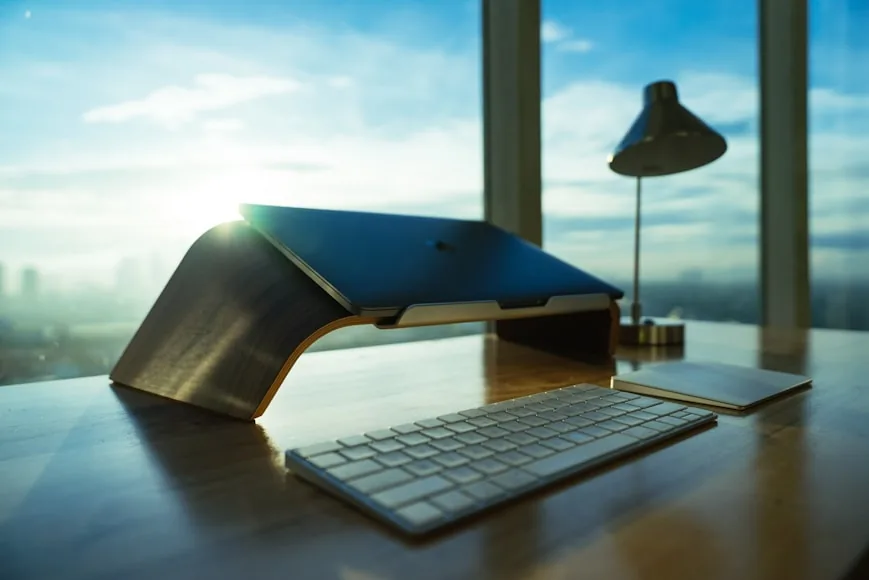
Twelve South Curve is the simplest good fixed stand in this category.
Twelve South lists it at 5.8 inches tall, 10.3 inches wide, and 8.7 inches deep, with a weight of 1.43 pounds and support for laptops at least 10.2 inches wide up to 7 pounds. Twelve South also says the one-piece stand is sturdy enough for typing directly on the laptop.
That is exactly why it earns a place here.
A lot of small-desk users do not need hinges, travel sleeves, or multiple lift positions. They just need:
the laptop screen higher than flat-on-desk level; a cleaner-looking footprint; a stable stand that does not need constant readjustment.
Curve is the clean choice when you want a stand that disappears into the desk visually and works the same way every day.
It is especially sensible if your laptop spends most of its time:
beside one external monitor; in a fixed work zone; paired with an external keyboard and mouse.
Strong fit for: small desks that already have a stable workflow and just need a fixed, reliable stand.
Main tradeoff: no height adjustment. If the fixed position is wrong for your body or desk, there is no fixing it later.
4. Roost V3 Plus
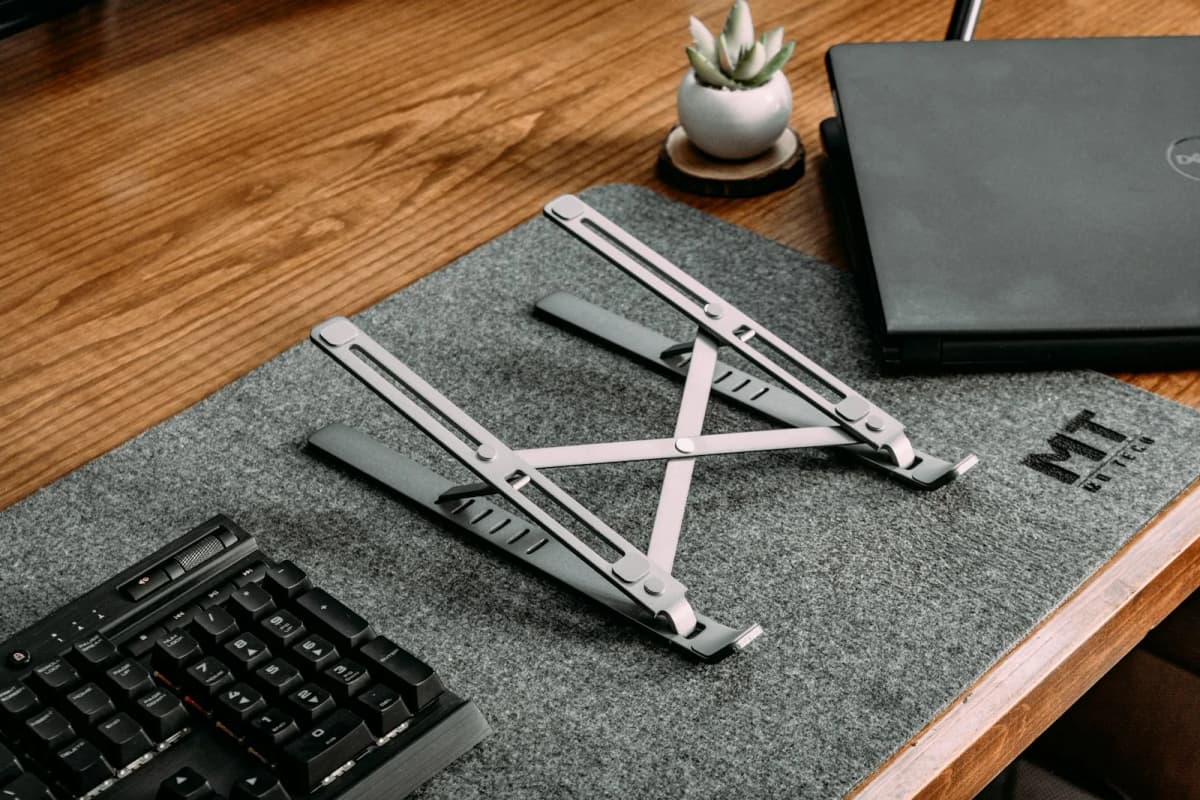
Roost V3 Plus is the pick when portability matters almost as much as ergonomics.
Roost says the V3 Plus has 11 height settings, provides 5 to 14 inches of screen lift for 12-inch to 18-inch laptops, weighs 6 ounces, and folds to 1 by 1.5 by 13 inches. That is an unusually strong spec profile for a stand that disappears into a bag.
For a small desk, the appeal is straightforward:
it packs away almost completely; it creates real lift, not just a small typing tilt; it works well for people who move between rooms, offices, and temporary setups.
This is not the stand I would buy just for desk aesthetics. It is the stand I would buy if the desk has to stay flexible and the stand should not behave like a permanent furniture decision.
It also works well if your workday switches between:
home desk; kitchen table; coworking space; travel or hotel setups.
Strong fit for: people who want serious lift without dedicating permanent desk space to a heavier stand.
Main tradeoff: it looks and feels more tool-like than the cleaner aluminum desk stands.
Fixed stand or adjustable stand?
For most small desks, that is the real decision.
Choose a fixed stand when:
the desk setup rarely changes; the laptop usually stays in one place; you want a cleaner visual footprint; the fixed height already works with your chair and desk.
Choose an adjustable or folding stand when:
the desk doubles as another surface; the laptop moves between workspaces; you need more control over height and angle; the desk depth is tight and layout changes often.
If you already know the laptop stays beside one monitor every day, a fixed stand like Curve can be enough. If the setup keeps changing, Curve Flex or the Branch Adjustable stand usually makes more sense.
What to measure before you buy
Do not buy a laptop stand until you check these:
- Laptop size and weight Stay inside the official support range, especially on lighter folding stands.
- Desk depth A stand can help, but it cannot magically create depth that is not there.
- Keyboard-and-mouse zone The stand should not steal the calm working space directly in front of you.
- Main use case Fixed home setup, side-screen workflow, travel, or pack-away desk all point to different stands.
- External peripherals The stronger the lift, the more important an external keyboard and mouse become.
If you have not checked desk depth yet, go next to How deep should a desk be for one monitor vs two?. If you are trying to balance one external monitor with the laptop beside it, How to set up one monitor and a laptop on a small desk is the more important companion guide.
When a laptop stand is not the right answer
Sometimes the better fix is not another stand at all.
If the laptop is usually closed and docked, a vertical stand can free more space than an open stand. If the external monitor is the true main screen, you may get more value from a better monitor arm or cleaner cable routing than from chasing the tallest laptop stand possible.
And if the desk is so shallow that even a slim stand pushes the keyboard to the edge, the real problem may be the desk dimensions, not the stand category.
That is where these guides matter more than another product purchase:
How high should your monitor be for good posture?; How to position your keyboard and mouse for shoulder comfort; Monitor arms that work on small desks.
Bottom line
For most small desks, the best laptop stand is the one that protects the working zone in front of you, not the one with the most dramatic marketing photo.
If you want the best all-around home-office option, start with the Branch Adjustable Laptop Stand. If you want the strongest premium folding design, Curve Flex is the better fit. If you want a simple fixed stand that just works, Curve is the cleanest answer. And if the stand has to travel with you, Roost V3 Plus is the easiest one to justify.
The right stand should make the desk feel calmer, not more crowded.
Related reading
- How to set up one monitor and a laptop on a small desk
- How to set up a small desk without losing usable space
- Vertical laptop stands for clamshell setups
- How to position your keyboard and mouse for shoulder comfort
- How high should your monitor be for good posture?
- Monitor arms that work on small desks