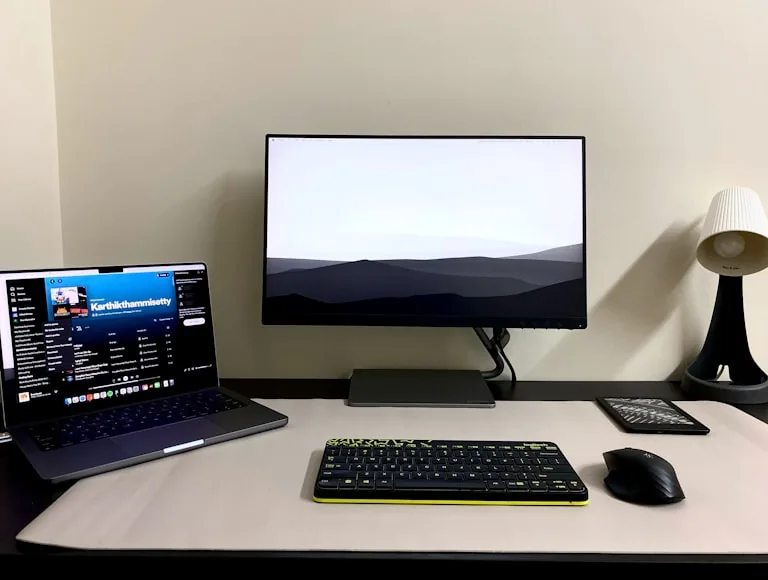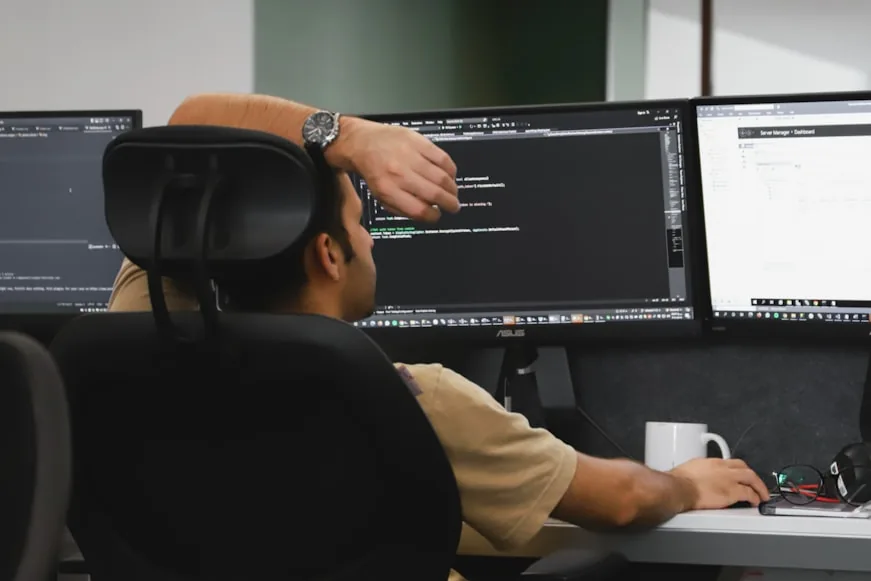

Working from a bedroom usually goes wrong when work stops being a contained activity and starts becoming the room's whole identity.
The desk is always visible, the chair never fully tucks away, the lamp feels like permanent equipment, and the bed ends up a few feet away from cables, screens, and half-finished tasks.
So the goal is not to make the bedroom feel more office-like. It is to make work fit inside the room without taking over how the room feels the rest of the day.
The official guidance points in a useful direction here even if it does not describe the problem in "bedroom" language. Cornell's flexible-work guidance says to choose a location with limited distractions and ample natural lighting, build regular breaks into the day, and maintain boundaries by unplugging at the end of work time. Mayo Clinic, OSHA, and CCOHS keep the workstation side equally clear: the monitor needs a comfortable viewing distance, the keyboard and mouse need a calm reach zone, and lighting should not create glare or force awkward posture.
Put together, that leads to a more practical bedroom rule:
build one restrained work zone that supports your body during the day and disappears emotionally as much as possible after work.
What usually works
If you want the shortest version, the pattern that usually works best is choosing the calmest workable edge of the room instead of the biggest empty patch, keeping the bed out of the direct work zone as much as the room allows, using a desk that supports the real workflow without trying to become a full office command center, keeping the chair, lamp, and storage visually lighter than a typical office setup, and building an end-of-day reset that turns visible work back into ordinary room furniture.
That is not about aesthetics for their own sake.
It is what keeps the bedroom from feeling like a work spillover zone at midnight.
1. Choose the calmest workable edge, not the largest empty spot
People often place the desk in whatever part of the room looks most empty.
That is not always the best move.
Cornell's remote-work guidance is more useful here: choose a location with limited distractions and ample natural lighting. In bedroom terms, that usually means choosing the calmest workable edge of the room, not just the biggest leftover rectangle.
That often looks like a side wall instead of the foot of the bed, a corner that does not interrupt the main walking path, a spot that can borrow window light without blocking curtains or creating glare, and a wall where the chair can move without turning the whole room into an obstacle course.
The wrong placement usually announces itself fast: you keep brushing past the chair, the desk visually dominates the room as soon as you walk in, the bed and desk feel merged into one zone, and the only way to use the desk is to ignore how the room actually moves.
If the room plan still feels fuzzy, How to plan a home office in a small room before you buy anything is still the best broader planning guide. This article is the bedroom-specific follow-up once the room itself is the main constraint.
2. Keep the bed out of the working field as much as possible
This does not mean every bedroom needs a separate office corner behind a divider.
It means the bed should stop feeling like part of the workstation.
In practice, that usually means not using the bed as the default desk chair, not turning it into the surface where chargers, papers, and devices drift during the day, avoiding a desk position that makes the bed the permanent backdrop for everything, and leaving at least a little visual or physical separation between sleep space and work space.
Sometimes that separation is small. The desk faces a wall instead of the bed, the chair tucks fully in, the lamp and monitor stay on one disciplined side of the room, and the bed area keeps its own nightstand, lighting, and rhythm instead of becoming overflow storage.
That matters because once the bed becomes part of the workflow, the room stops feeling like it has two modes.
It just feels like unfinished work with a mattress nearby.
If the larger problem is that the entire room has to do double duty, Home office setup ideas for small apartments is the better companion guide.
3. Build one restrained workstation, not a miniature office scene
This is where a lot of bedroom setups quietly get worse.
People start with a desk and monitor, then keep adding the visual language of a full office: a large lamp, storage trays, extra organizers, open stands, side furniture, visible audio gear, and more permanent desk residents than the room can calmly support.
That usually makes the room feel more corporate, not more workable.
The better rule is simpler:
give the desk one clear job and only a few permanent objects.
Usually that means one main screen, one keyboard-and-mouse zone, one controlled writing area if your work actually needs it, one lighting solution, and one power or charging path that does not leak across the room.
If you need more than that, the solution is usually better planning or better zoning, not more visible equipment.
That is exactly where How to set up a small desk without losing usable space and Why more desk accessories rarely fix the real problem become important. They both solve the same deeper issue: the room starts feeling worse when every new frustration becomes another object.
4. Use furniture that can visually disappear after work
The best bedroom workstations do not usually look like the most "fully featured" ones.
They look like the ones that can sit quietly in the room once the laptop closes.
That usually means being more disciplined about desk depth, chair bulk, under-desk clutter, visible cable mess, and whether the furniture reads like calm room furniture or permanent equipment.
This is where people often overbuy.
A desk can technically fit and still be too deep, too heavy-looking, or too ambitious for the room. A chair can be supportive and still feel visually overbuilt in a bedroom if it flares too wide, never tucks in, or dominates the room from the doorway.
The cleaner target is a desk sized for the real workflow rather than a fantasy one, a chair that supports real work but still tucks in cleanly, as little side furniture as possible, and under-desk hardware that stays restrained.
If you are still figuring out the desk side, 7 questions to ask before buying a desk for a small room is the best pre-buy filter. If the chair is the bigger room-fit question, Office chairs that fit small home offices is the cleaner next step.
5. Solve lighting and glare before decoration
Bedroom workstations are especially sensitive to lighting mistakes because the same room has to support alert daytime work and calmer evening use.
Cornell is right to prioritize natural light, but OSHA and CCOHS are just as clear about the other half of the problem: windows, lamps, and bright light sources should not create glare or reflections that push you into awkward posture.
That usually leads to a more restrained lighting approach: place the workstation so window light helps the room without hitting the screen directly, keep bright windows at the side of the monitor instead of directly in front or behind it, use blinds or curtains if daylight turns into glare, and choose a slimmer lamp or light bar if a large lamp base would steal the only calm corner of the desk.
This is one reason bedroom setups usually benefit from cleaner lighting choices more than bigger ones do. A bulky lamp does not just take space. It makes the room feel more instrumented all day.
If lighting is the main unresolved problem, Do you need a monitor light bar if you already have a desk lamp? and Desk lamps for eye strain and late-night work are the best follow-ups.
6. Protect the body basics even in a bedroom
The room can feel calm and still be uncomfortable to use.
That is why the workstation basics still matter even when the bedroom mood is the bigger concern.
Mayo Clinic and OSHA stay consistent on the important parts: the monitor should sit about an arm's length away, the keyboard and mouse should stay directly in front of you and within easy reach, the desk needs enough room for the things you use constantly, and the area under the desk still needs to leave room for knees and feet.
That is the part people often compromise in a bedroom.
They choose the smallest possible desk, use the prettiest chair, or let lighting and storage steal the only workable zones, then wonder why the setup feels tiring even though it "fits."
If that sounds familiar, Why your small desk setup still feels cramped is the right diagnosis page. If the discomfort is broader than space pressure, What makes a home office comfortable enough to use all day? is the stronger authority follow-up.
7. Make the end-of-day reset part of the setup
This is the bedroom-specific rule that matters most.
Cornell explicitly recommends maintaining boundaries and unplugging at the end of work time. That advice gets much more important when the workspace lives in the same room where you sleep.
If the setup stays visually and mentally "on" all evening, the room never really resets.
That is why a good bedroom workstation should make shutdown easy: the chair tucks in without a fight, the laptop closes or docks cleanly, cables do not spill onto the bed side of the room, notebooks and devices have one contained home, and the lighting can shift from task mode back to room mode quickly.
The best version of this is not complicated.
It is just a setup that lets you put work away in under two minutes instead of needing a whole nightly cleanup ritual.
If you cannot do that, the room is probably carrying too many visible work decisions all day long.
If the next goal is making the setup feel more intentional instead of more office-like, What makes a desk setup feel premium without wasting space or money is the cleaner follow-up.
Red flags that mean the bedroom still feels too much like an office
If two or three of these sound familiar, the room usually needs a tighter plan, not more gear: the bed has become overflow storage for work items, the desk is the first thing your eye hits when you enter the room, the chair never fully tucks away, lighting for work makes the room feel harsh after dark, the monitor, lamp, and chargers are all visible from the bed, the only way the setup works is by adding more small support objects, or ending work never feels like the room actually changes mode.
That is usually the real giveaway.
The bedroom is not failing because it is small.
It is failing because work does not have a contained footprint yet.
Bottom line
Working from a bedroom without making it feel like an office usually comes down to restraint and boundaries.
The setup works best when the workspace lives on one believable edge of the room, the bed stays out of the active work zone, the desk supports the real workflow without turning into a full office scene, lighting helps the task without making the room harsher, and the end-of-day reset is built into the setup itself.
That is what keeps the room from feeling hijacked by work.
And it is usually the difference between "I can technically work here" and "this still feels like my bedroom when the day is over."
Related reading
- Why your desk setup feels tiring even when it looks fine
- How to plan a workspace in a small room before you buy anything
- Home office setup ideas for small apartments
- 7 questions to ask before buying a desk for a small room
- Why your small desk setup still feels cramped
- How to set up a small desk without losing usable space
- What actually makes a workspace comfortable enough to use all day?
- Why more desk accessories rarely fix the real problem